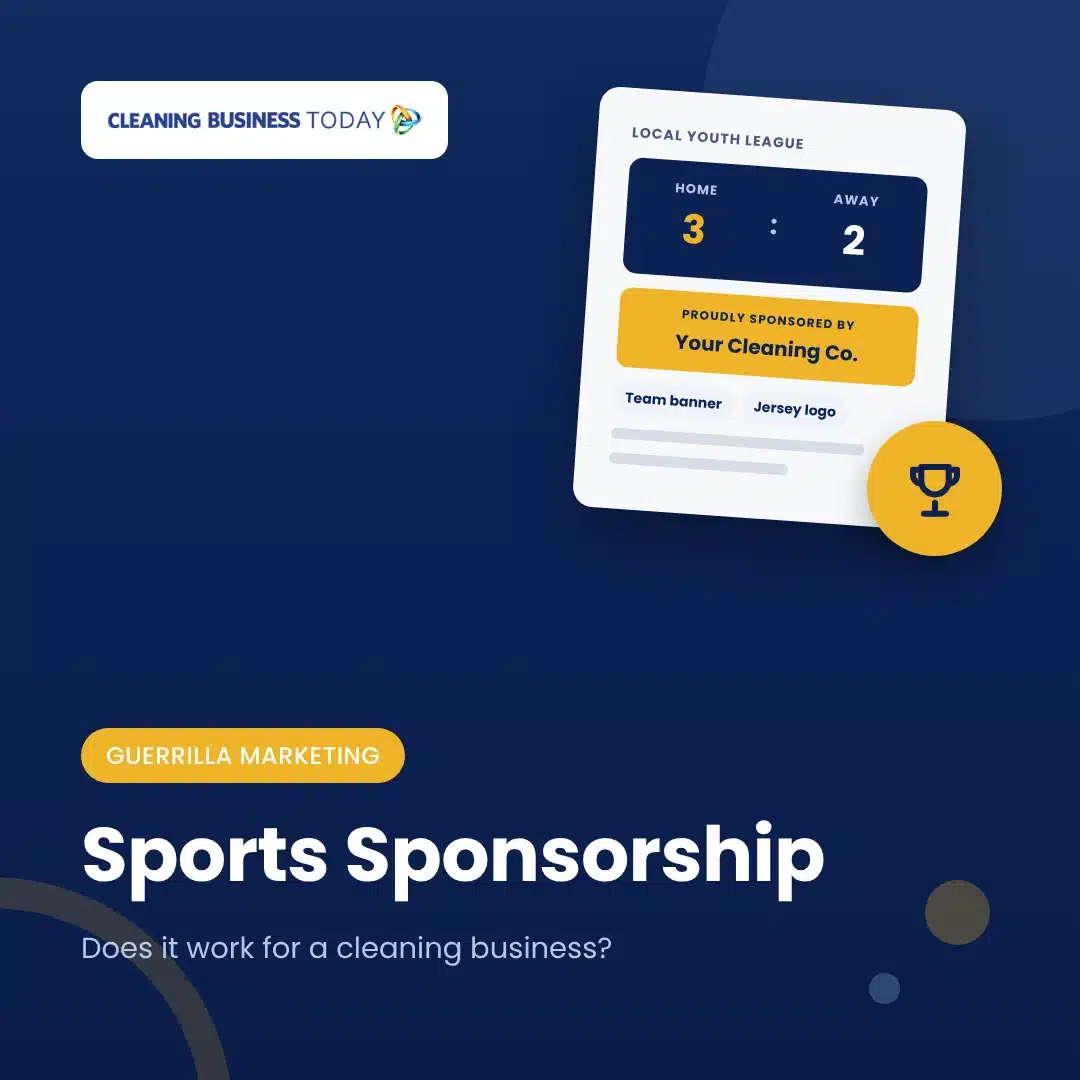
Yes, sports sponsorship works for a cleaning business when you back local teams and leagues in the neighborhoods you already serve. What has changed since this tip first ran in 2014 is the format: arena step ads still exist, but youth and rec-league packages with jerseys, banners and social shout-outs usually fit a cleaning company better.
The Original Tip Does It Still Work? Then vs. Now Types of Sponsorship Reading a Package Choose and Track Quick Summary FAQ
Editor's note: This article first appeared in June 2014 as Tip #28 in CBT's Guerrilla Marketing series by CBT co-founder Derek Christian. We've kept the original tip below and added an October 2026 update on sponsoring local teams today.
The Original 2014 Tip: Arena or Escalator Steps
Place your message in places people always look - like steps in a public place.
I usually like to focus on no or low-cost marketing ideas, but this one is just too fun not to include.
Many Americans spend leisure dollars and lots of time at various sporting venues: hockey rinks, football stadiums, baseball parks, basketball courts, and more. And all of these facilities have steps - lots and lots of steps. And most people look at steps when they are walking up more so than when they're walking down.
So take advantage of that front face of the step. The arenas near you may not offer such an advertising possibility, but most are willing to work out an advertising deal. Check out these arena steps bolding advertising my friend Stephanie Nesseth's cleaning business Absolutely Clean in Marion, Iowa.

Does Sports Sponsorship Still Work in 2026?
Yes, but the version that works best has moved from the arena to the local ballfield. Derek's core point still holds: a sign placed where fans naturally look gets noticed.
The difference is who is watching. An arena draws fans from across a metro area, many of them far outside your service area. A youth soccer or Little League game draws parents from a few nearby neighborhoods, and busy families are a core market for residential cleaning.
Those families also spend real money to keep kids playing. The Aspen Institute's Project Play survey found that families spent an average of $1,016 on a child's primary sport in 2024, up 46% since 2019. That cost pressure is why leagues actively seek local business sponsorship, and why a modest check earns real goodwill. Our verdict: sports sponsorship still works for a cleaning business, but how you do it has evolved.
Then vs. Now: Arena Ads vs. Local Team Sponsorships
The goal is the same as in 2014, but the audience and the follow-up have changed.
Arena Step Ads in 2014 vs. Local Sports Sponsorship Today
| Factor | 2014 | Today |
|---|---|---|
| Typical placement | Step faces, rink boards and concourse signs at large venues | Jerseys, field banners, game-day announcements and team social media posts |
| Audience | Fans from across the region | Local families in specific neighborhoods |
| Main goal | Name recognition from repeat exposure | Recognition plus goodwill with neighbors who see you supporting their kids |
| What prospects do next | Remember the name or phone number | Search the business name on a phone or tap a link on the team's page |
| Tracking | Rarely tracked | Tracked with a dedicated offer code, tagged link or call tracking number |
| Relationship | A one-way ad buy with the venue | An ongoing partnership with coaches, parents and league volunteers |
Types of Sports Sponsorship for Local Businesses
Cleaning business owners usually choose from five options, depending on budget and how tightly they want to target their service area. Each sports organization sets its own benefits.
Local Sports Sponsorship Options Compared
| Option | Typical Benefits | Best For |
|---|---|---|
| Youth sports team | Name or logo on jerseys, a sponsor plaque and thank-you posts | New owners who want a low-cost start in one neighborhood |
| League | Field banners, a listing on the league website and mentions in league emails | Established companies that cover several neighborhoods |
| Tournament | Event banners, a program ad and often a booth or table | Owners who want a short burst of exposure and a chance to collect leads |
| School athletics | Fence or scoreboard signs, program ads and PA announcements at home games | Companies with clients concentrated near one school |
| Venue signage | Rink boards, step faces or concourse signs, as in the original tip | Larger companies whose service area matches the venue's crowd |
Before signing with a school, ask the athletic director whether the district has rules on what sponsors can display. Read a youth league's rules too. Little League's sample local sponsorship agreement says local sponsors can't use the Little League Baseball and Softball marks and have no say over managers, coaches or players.
That point matters for your own marketing. In one case Little League shared with local leagues, a sponsor's TV commercial featuring uniformed players aired without approval, and the league lost the sponsor once the spot was pulled. Get written permission before you use team names, logos or player photos in your ads.
What You Get: Reading a Tiered Sponsorship Package
Most leagues and booster clubs sell tiered sponsorship packages, and each level adds visibility. Youth sports sponsorship tiers often carry names like bronze, silver and gold, so compare what each level actually includes rather than the label.
Logo Placement on Jerseys
Families see your name at every game and in every team photo. Ask how large the logo will be and whether the jerseys are reused next season.
Field Banners and Signage
Outfield, fence and gym banners reach everyone at every home game. Confirm how long the banner stays up and who pays for printing.
Social Media and Website Mentions
Team and league posts reach parents between games, when they have time to look you up. Ask how many posts are included and whether they'll link to your website.
Game-Day Recognition
Game-day perks include PA announcements, a table at opening day and sponsor appreciation nights. That face time is your best chance to collect contact information, using the contest approach in our tip on raking in leads at summer events.
To judge a package, weigh the price against what you'll realistically get: the number of home games, the size of the league's email list and the number of posts. A smaller package in your best zip codes usually beats a premium one across town.
How to Choose and Track a Local Sports Sponsorship
Choose teams by geography first, then measure the sponsorship like any other ad.
Match the Team to Your Service Area
Map where your best clients live and sponsor the leagues that draw from those neighborhoods. Ask the league for its boundaries or the schools its players attend, and favor teams with ties to your employees or clients.
Use a Dedicated Offer Code
Give the sponsorship its own offer, such as a first-clean discount for team families, with a code used nowhere else. Put it on the banner and in team emails, with a QR code that leads to a landing page. On game days, park your branded vehicle near the field, as suggested in our updated car wrap advertising tip.
Set a Measurement Plan
Tag every sponsorship link with UTM parameters so its traffic shows up separately. Google's documentation explains that the source, medium and campaign parameters identify where visits came from. At season's end, count the leads and booked jobs tied to your code, then compare them with the cost using CBT's guide on how to measure marketing success.
Some value won't show up in the numbers. Sponsorship builds the same reputation and employee pride described in how community involvement projects help grow your cleaning business. You can extend it by pairing the team with a local cause, as in our updated tip on cause marketing, or by championing a charity through every part of your business.
Finally, ask your accountant how to record the expense. Federal regulations generally treat goodwill advertising that keeps a business's name before the public as a deductible business expense, but your accountant should confirm how your specific payment is handled.
Quick Summary
- Sports sponsorship still works for a cleaning business, especially with youth teams and leagues in your service area.
- Options range from a single youth team to league banners, tournaments, school athletics and venue signs.
- Compare tiered packages by what each level delivers: jerseys, banners, social posts and game-day mentions.
- Track results with a dedicated offer code and tagged links, and get permission before using a league's name or logo.
Frequently Asked Questions
It varies widely by league, sport and market, so ask each league for its sponsorship packet. Most offer tiered packages, from a single team jersey or banner at the low end to league-wide packages with signage, email mentions and game-day recognition at the top.
Common sponsor benefits include your logo on jerseys, field or gym banners, social media and website mentions, and PA announcements or a table on game day. The exact mix depends on the tier you buy, so get the list of benefits in writing before you pay.
Often, yes. Federal regulations generally allow goodwill advertising that keeps a business's name before the public as an ordinary business expense, but how your payment is treated depends on what you receive and who you pay. Check with your accountant before you file.
Start with the leagues and schools that draw from the neighborhoods where your best clients live. Ask employees and clients whose kids play, contact league boards and athletic directors directly, and watch for sponsorship requests at the start of each season.
Author

Recommended Reading
Here's a short list of reads we think you'll enjoy.
First on the list is What to Post on Social Media for Business: Then vs. Now, which covers the case for mastering one social media platform instead of many, plus a comparison of the major networks.
Another good read is Small Budget Marketing, which covers low-cost client-building tactics such as referral newsletters, neighborhood postcards and a simple website that collects quote requests.
Also worth a look is Networking Tips to Help You Build Your Business, which covers the groups, elevator pitch and referral habits that help commercial cleaning owners build trust through in-person networking.
Wrapping things up, ESTABLISHING AND PROTECTING YOUR BRAND, which breaks down the franchise-style systems, consistent service and visual identity that help an independent cleaning company become the local brand.