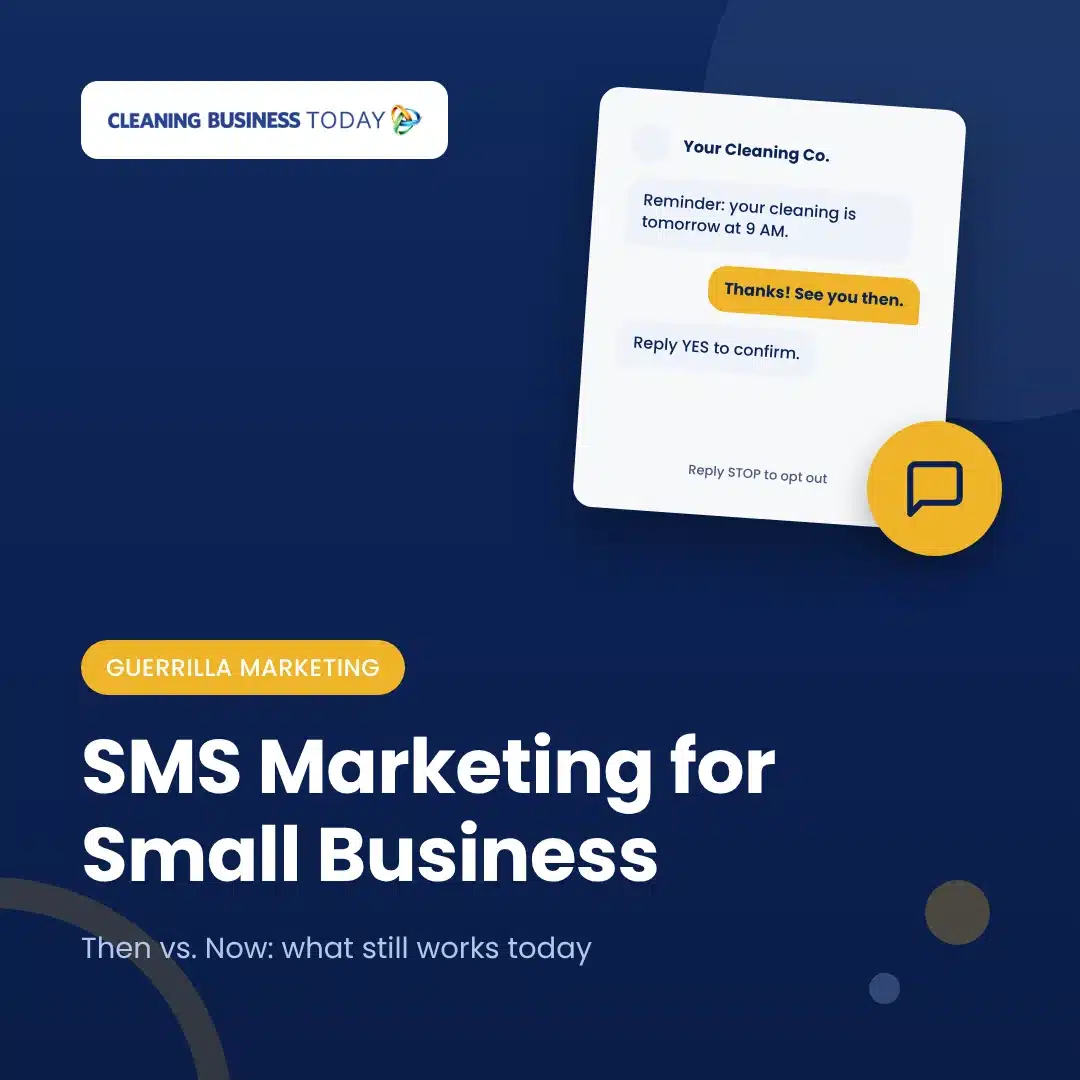
Text signatures still help a cleaning business, but SMS marketing for small business has grown from a simple branding touch into a full marketing channel with its own consent and registration rules. What changed since this tip first ran in 2014 is how owners use texts, which tools send them and what the law requires.
The Original Tip Does It Still Work? Then vs. Now What to Text Is It Legal? Choosing a Platform Your Text Signature Quick Summary FAQ
Editor's note: This article first appeared in September 2014 as Tip #30 in CBT's Guerrilla Marketing series by CBT co-founder Derek Christian. We've kept the original tip below and added an October 2026 update on text message marketing and the rules that now come with it.
The Original 2014 Tip: Text Signatures
Increase your brand awareness with text signatures.
If you are using text messaging in your business operations - and you should be, especially if you are targeting any market in the millennial age group - be sure to use a simple but informative text signature.
Just as with an email signature, you program it in and it automatically attaches to every text message you send out.
So what should it be? Simple and short - under 40 characters short - so most will look something like this:
Derek
My Maid Service
Cleaning Homes since 1997And if you think your personal (non-customer) friends should be sending you more referrals, maybe they could use a little reminder from your text signature. So if you keep a separate personal cell line, use the same signature there.
Brand awareness activities like this often take the least amount of time and money, but really work hard for you over the long haul.
Does Texting Customers Still Work for a Cleaning Business?
Yes, and it matters far more than it did in 2014. Pew Research Center found that 98% of U.S. adults own a cellphone and 91% own a smartphone, so nearly every client you serve can receive a text.
Derek's core idea holds up: every message you send is a small chance to reinforce your brand. What has evolved is the scale. In 2014, texting was mostly one owner sending messages from a personal phone. Today, SMS marketing for small business means software that sends reminders, review requests and offers to hundreds of clients at once. That reach brings federal consent rules and carrier registration requirements, so our verdict is that the tactic has evolved rather than expired.
Then vs. Now: How Text Messaging Changed for Cleaning Businesses
The phone in your pocket is the same tool, but the way a cleaning company uses it for marketing looks very different.
Text Signatures in 2014 vs. SMS Marketing Today
| Factor | 2014 | Today |
|---|---|---|
| Main purpose | Brand awareness on one-to-one texts | Reminders, review requests, rebooking offers and two-way customer service |
| Who sends | The owner or office manager from a cell phone | Scheduling or SMS marketing platforms using a business number |
| Branding | A signature under 40 characters | Business name in every message, plus consistent tone and links |
| Consent | Rarely considered | Documented opt-in, with written consent for marketing texts |
| Carrier rules | Few practical limits on volume | A2P 10DLC brand and campaign registration for business texting from local numbers |
| Opting out | Informal | STOP and similar replies honored quickly, with records kept |
What Cleaning Businesses Text Customers Today
The most useful texts for a cleaning company support the service first and sell second. Clients welcome messages that save them time, and that goodwill makes occasional offers easier to send.
Appointment Reminders
A reminder the day before a clean cuts down on lockouts and last-minute cancellations. CBT's look at ways to increase revenue from cleaning services via text covers confirmations that make sure someone will be home or has left a key.
On-My-Way Messages
A short note when the team leaves the previous job tells clients when to expect the crew. Some owners include the cleaner's first name or photo, which helps clients who are uneasy about letting someone new into their home.
Review Requests
A text sent soon after a clean, with a direct link to your Google review page, is one of the easiest ways to build ratings. Our guide on why online reviews matter and how to collect more of them explains why automating this step pays off.
Rebooking and Seasonal Offers
Promotional texts work best for past or occasional clients: a spring cleaning slot, a move-out special or a gentle nudge to book again. These are marketing messages, so they carry the strictest consent requirements covered below.
Texting also works for new leads. Our article on how to generate more leads and close more sales with texting shows how to invite prospects to text you first, which gives you a clear starting point for consent.
Is SMS Marketing Legal? Consent, the TCPA and Opt-Outs
Yes, texting customers is legal when you have the right consent and honor opt-outs. The Telephone Consumer Protection Act (TCPA) and the FCC rules under it treat texts much like calls, and violations can be costly. Check with your attorney before you launch a marketing program, since state laws can add stricter requirements.
Get the Right Consent
Under the FCC's TCPA rules at 47 CFR 64.1200, autodialed marketing messages require the recipient's prior express written consent. That agreement must clearly authorize the messages and state that agreeing is not a condition of buying anything. Service messages such as appointment reminders still need prior express consent, so collect phone numbers with a clear explanation of how you'll use them.
Respect Opt-Outs and Quiet Hours
The FCC's 2024 consent revocation order in the Federal Register says a reply such as "stop," "quit," "cancel" or "unsubscribe" is a reasonable way to revoke consent. Opt-outs must be honored within a reasonable time, not to exceed 10 business days, and the FCC set April 11, 2025 as the effective date. You may send one confirmation text with no marketing content. The same rules bar telephone solicitations to residential subscribers before 8 a.m. or after 9 p.m. local time, and keeping promotional texts inside that window is the safe practice.
Follow Carrier Guidelines
Wireless carriers add their own expectations. The CTIA Messaging Principles and Best Practices ask senders to document each opt-in, disclose how often messages will arrive and any charges, and explain how to opt out with "STOP."
Register Your Business Number
If your software sends texts from a local 10-digit number, carriers require A2P 10DLC registration. Twilio's A2P 10DLC overview explains that you register your brand and a campaign describing your messages and opt-in process. Twilio has blocked unregistered 10DLC traffic since September 1, 2023, so an unregistered number can stop delivering texts.
Choosing an SMS Marketing Platform for a Cleaning Business
The right platform is often the one you already use. For most owners, text marketing for small business starts inside their scheduling software. Many cleaning scheduling programs include reminder and review texts, and adding a standalone tool only makes sense when you need features your software lacks.
SMS Platform Features That Matter
| Feature | Why It Matters |
|---|---|
| Scheduling software integration | Sends reminders and on-my-way texts from real job data without double entry |
| Consent and opt-out tracking | Records who agreed to which messages and stops texts automatically after STOP |
| 10DLC registration support | Walks you through brand and campaign registration so messages get delivered |
| Two-way texting | Lets clients reply with questions, photos or schedule changes |
| Send-time controls | Keeps promotions inside allowed hours in each client's time zone |
| Clear pricing | Shows message limits, overage rates and any registration fees |
Check how a platform counts messages. Twilio's guide to the SMS character limit explains that a standard segment holds 160 characters, but one emoji can cut that to 70, and providers bill by segment. Twilio's own U.S. SMS pricing lists $0.0083 per segment plus carrier fees, which shows that the underlying cost is small and that most of a platform's price pays for its features.
Your Text Signature, Updated
Derek's advice to keep a short, consistent signature still applies, but software now does most of the work. Most texting platforms add your business name automatically or let you save it as a template, so clients always know who is texting them.
For one-to-one texts from your own phone, a signature like Derek's example still works: a first name, the company name and one short line. Keep it short enough that it doesn't push a reminder past 160 characters, and match the details to your updated email signature so clients see the same brand everywhere.
The same thinking runs through the rest of the series. Our tip on customizing receipts and invoices puts your brand on every bill, and our tip on upgrading your phone demeanor covers the calls that often follow a text.
Quick Summary
- SMS marketing for small business has evolved from a text signature into a full channel for reminders, reviews and offers.
- Get prior express written consent before sending marketing texts, and honor STOP replies within 10 business days.
- Register any local business number for A2P 10DLC, or carriers may block your messages.
- Keep a short signature with your business name, and choose a platform that tracks consent.
Frequently Asked Questions
Yes, SMS marketing is legal when you have the right consent and honor opt-outs. Under the FCC's TCPA rules, autodialed marketing texts require the recipient's prior express written consent, and opt-out requests such as "STOP" must be honored within 10 business days. State laws can add stricter rules, so check with your attorney before launching a marketing program.
The underlying cost per text is small. Twilio lists U.S. SMS at $0.0083 per 160-character segment plus carrier fees, while most SMS marketing platforms bundle messages into monthly plans. Many cleaning scheduling programs also include reminder texts, so check what your current software offers before buying a separate tool.
The most useful texts are appointment reminders, on-my-way messages, review requests after a clean and occasional rebooking or seasonal offers. Service messages build goodwill, which makes clients more receptive to the occasional promotion. Marketing texts need written consent, so keep promotional offers to clients who have opted in.
Federal rules don't set a fixed number, but you should text only as often as you told clients to expect when they opted in. CTIA's messaging guidelines ask senders to disclose message frequency up front. For most cleaning businesses, that means service texts tied to each appointment and promotional texts no more than a few times a month.
Author

Recommended Reading
Here are some related articles that go a bit further.
To kick things off, take a look at Building an Automated Cleaning Business, where you'll find the systems one maid service owner uses to automate online booking, nightly confirmation texts, payments and staff scheduling.
You might also like Do I NEED Scheduling Software?, where you'll find the signs a cleaning company has outgrown paper planners and shared calendars, plus tips for testing scheduling software.
Another one worth checking out is Email marketing to your leads, that explores a persistent email follow-up schedule for cleaning leads, with content ideas that help prospects book.
We'll wrap up with Improving client retention at your house cleaning company, which walks through practical ways to keep house cleaning clients longer, from clear expectations and follow-up calls to consistent cleaner assignments.