What a K-Shaped Economy Means for Your Cleaning Company — and How to Stop Managing Your Customers Like They're All the Same
The economic headlines right now are genuinely confusing. Depending on which number you look at, the economy is either fine or it isn't. Both things seem true at once.
That's not an accident. It's a K-shaped economy — and once you understand the concept, a lot of what you're seeing in your own business starts to make more sense.
Liz Trotter and I dug into this during a recent Smart Business Moves session focused on protecting profit in a shifting market. I want to share the key ideas here because I think this framing is genuinely useful for cleaning business owners trying to make sense of customer behavior right now.
What "K-Shaped" Actually Means
A K-shaped economy describes what happens when economic conditions don't hit everyone the same way.
Picture the letter K. The upper branch goes up. The lower branch goes down. Two groups, same economy, moving in different directions at the same time.
The upper branch includes people with higher incomes, stronger savings, appreciating assets — especially financial assets like stocks and home equity — and stable employment. The lower branch includes people who are more exposed: higher debt loads, less savings, more sensitivity to rising prices, less job security.
A January 2026 report from U.S. Bank's economics research team found that U.S. income inequality has returned to a 60-year peak — and that the share of Americans considered middle class has shrunk from 61% in 1971 to barely a majority today. U.S. Bank Chief Economist Beth Ann Bovino noted there is no reason to believe that gap has narrowed since the most recent measurement.
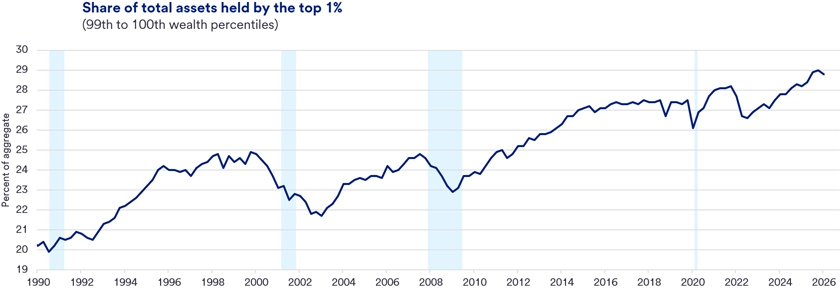
A fair question is how settled this picture really is. The Federal Reserve Bank of Minneapolis reviewed all available data sources in March 2026 and concluded the full story is more complicated than the headlines suggest — different datasets show different magnitudes of the split. That's worth knowing. But what the Minneapolis Fed found consistent across nearly every data source, including Moody's Analytics, Bank of America Institute, and the New York Fed, is that higher-income households are spending at meaningfully faster rates than lower-income ones. According to Moody's data reviewed in that piece, the top 10% of earners now account for more than 45% of all consumer spending in the U.S.
The reason that matters for your cleaning business is simple: both groups are in your customer base. And they are not behaving the same way.
One Economy, Two Customer Realities
I've seen this play out at Castle Keepers. You look at your customer list and the patterns don't make sense as a whole — but they make a lot of sense once you start looking at the segments.
Some customers are holding steady or adding service. They're booking add-ons. They're not flinching at price increases. They value their time, they trust the team, and they're not in cost-cutting mode.
Other customers are doing the opposite. Skipping cleans. Moving from weekly to biweekly. Asking about reducing scope. Comparing prices more actively than they used to.
The data confirms what I'm seeing in the field. Bank of America Institute transaction data from late 2025 showed that spending from consumers in the top third of the income distribution rose 4% year-over-year in November — the fastest growth rate in four years. Spending from households in the lowest third rose less than 1% over the same period. That gap is not a rounding error. It's a fundamentally different economic experience playing out in two groups who might both be on your client list.
Federal Reserve economists at the New York Fed went further. Using a panel of 200,000 consumer spending records, they found that since 2023, real spending growth has been driven almost entirely by households earning more than $125,000 per year. Low-income households actually saw real purchasing power decline during part of this period. And a companion Fed study found that two compounding forces are driving the divergence: lower-income households have consistently faced above-average inflation, while higher-income households have seen outsized gains in financial wealth — with the net worth of the top income percentile growing more than 25% since early 2023.

Here's where it gets counterintuitive. Consumer sentiment right now is near record lows — but retail spending is still holding up. A May 2026 Forbes analysis by retail researcher Greg Petro explains the paradox: consumers aren't stopping spending. They're trading down — reallocating from one category to another, reducing scope rather than eliminating it entirely.
This is the more accurate picture of what's happening in cleaning businesses right now. Many of your clients in Phase 2 and Phase 3 haven't decided to stop valuing a clean home. They're deciding to clean fewer rooms, less often, or at a reduced scope. That's a different problem than a cancellation — and it calls for a different response. The clients who reduce scope and stay are far easier to retain than the ones who cancel and disappear.
One specific mechanism is worth naming: shelter costs. When housing and rent costs rise — and they have risen significantly since 2021 — the household budget math changes for middle-income earners in particular. More dollars going to housing means fewer dollars available for discretionary services. Cleaning moves up the "luxury" spectrum for many households even when nothing else about their life has visibly changed. They didn't decide cleaning was less important. They just have less discretionary cash left after fixed costs.
That's the world your clients are living in right now. Not all of them — but more of them than the headline numbers suggest.
Where Cleaning Businesses Feel It First
One of the most useful frameworks Liz brought to the SBM session maps consumer behavior through the five phases of economic stress. Cleaning businesses don't wait for a recession announcement to feel the pressure. We typically feel Phases 2 and 3 well before broader recession headlines catch up.
| Phase | Consumer Behavior |
| 1. Anxiety | Confidence drops emotionally |
| 2. Adjustment | Trade-downs begin |
| 3. Optimization | Selective spending increases |
| 4. Protection | Nonessential spending reduced |
| 5. Retrenchment | Major cuts and cancellations |
Residential cleaning businesses often feel Phases 2 and 3 long before broader recession headlines appear. Framework developed by Liz Trotter, Core Profit Builders.
When a client moves from weekly to biweekly, that's Phase 2. When they start asking about "just the main areas," that's Phase 3. By the time they're in Phase 4 or 5, the conversation is much harder. The owners who are paying attention to Phase 2 and 3 signals in their own data right now have time to respond thoughtfully. The owners who wait for the economy to "officially" turn will be catching up.
The Two Groups Inside Your Own Team
Here's the dimension of the K-shaped economy that most cleaning business owners don't talk about, but should.
Your customers are split between the upper and lower branches of the K. So is most of your staff.
Cleaning technicians — most of them — fall into the lower arm. They're in the income bracket that's facing above-average inflation on food, gas, and shelter. Their paychecks cover less than they did three years ago even if the dollar amount has gone up. When clients are cutting back because money is tighter, that same economic pressure is hitting your employees at home.
This creates a dynamic that's easy to miss if you're only watching your customer-facing metrics. A technician who seems like a reliability problem might actually be dealing with a car that needs repair, a rent increase, or a food budget that's been quietly stretched for months. That instability has a way of showing up at work before it shows up in any direct conversation with you.
This matters operationally in two ways. First, your team's financial stability affects your service quality and your retention. High turnover is expensive in any market — it's more expensive when you're simultaneously managing customer-side pressure. Second, the message you deliver to your team during an uncertain period needs to acknowledge that they're feeling the economy too, not just your clients. Culture as stability support isn't a soft concept right now. It's a practical one.
The three stakeholders in your business — you, your team, and your customers — don't experience the economy in the same way, at the same time, or with the same tools to absorb it. Strong operators understand all three positions at once.
What This Means for Your Marketing
If your customer base is split, your messaging probably needs to be too — at least in how you're thinking about it.
For higher-value customers who aren't in cost-cutting mode, the message is about consistency, trust, and what their time is worth. These customers aren't shopping for the lowest price. They're staying with you because the experience is reliable and the relationship is solid. That's worth reinforcing — not with discounts, but with communication that reminds them why they chose you.
For customers who are feeling more financial pressure, the conversation is different. It might be about flexible scheduling options, a maintenance clean that covers priorities rather than a full-scope visit, or a frank conversation about what they can afford right now versus what would cause them to cancel entirely.
Something Liz said in the SBM session has stuck with me — and I think it's the most useful reframe in this whole conversation:
"Your competition is not another cleaning company. Your competition is shrinking discretionary cash flow."
Liz Trotter, Core Profit Builders
That reframe matters. In Phase 2 and Phase 3, you're not trying to out-market a competitor. You're trying to remain the thing your client chooses to keep when choices get made.
McKinsey's Q2 2026 consumer sentiment research found that even higher-income consumers are beginning to pull back on discretionary spending — not at the same rate as lower-income households, but moving in that direction. Only 35% of consumers reported feeling optimistic about the economy in Q2 2026, a two-year low. That means even your most stable clients may be in a more watchful frame of mind than they were a year ago. This is not the time to assume that your premium relationships are on autopilot.
The Kearney management consulting firm put it well in research cited by Forbes: brands that race to the bottom on price and brands that assume immunity at the premium end are making the same mistake. As Kearney found, consumers across income levels are increasingly sensitive to value mismatches — not just price points. Their prescription for winning businesses applies directly to cleaning companies: make it easier for clients to justify meaningful spend where it makes sense, rather than demanding loyalty across every category and every visit.
In practical terms: be the company that has a thoughtful conversation about scope before the client goes silent. That conversation isn't a concession. It's retention.
The goal is not to become the cheapest option in the market. It's to understand which customers you're talking to and what decision they're actually making.
What This Means for Pricing
Here's where I want to be direct: a K-shaped economy is not a reason to avoid price increases.
I've seen owners freeze on price adjustments because they're worried about losing customers. I understand that instinct. But avoiding a necessary price increase doesn't protect your business — it erodes your margin quietly while your costs keep climbing.
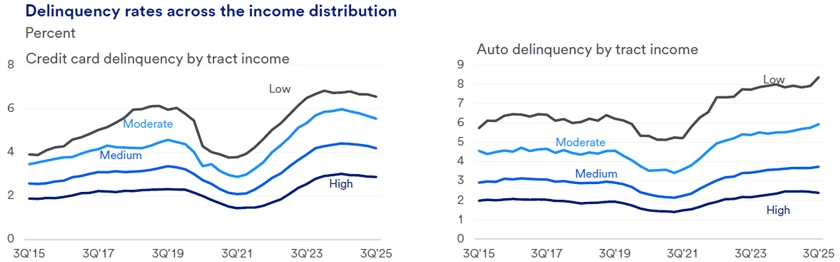
One reason some customers look like they're holding steady when they're actually fragile: they're carrying debt to do it. The U.S. Bank research team flagged rising delinquency rates — particularly in auto loans — among lower-income households as a signal that some of that apparent spending stability is being financed on credit. A customer who seems to be handling the current price just fine may be one unexpected expense away from pausing service.
That's not a reason to panic. It's a reason to be thoughtful about which customers get which pricing conversations.
Some customers will accept higher rates when the value is clearly communicated. Some may need a modified scope of service at the same price point. A small segment may not be the right fit for your current pricing at all. That's not failure. That's management.
The owners who get into trouble are the ones who apply blanket logic — either raising rates across the board with no communication, or holding rates flat for everyone because they're afraid of the reaction. Neither approach reflects the actual variation in your customer base.
The Real Job: Stop Managing Your Customers as One Group
This is the biggest shift in how I think about the K-shaped economy.
The owner's job right now is to stop looking at the customer base as a single number and start looking at it as a set of segments. Who's profitable? Who's underpriced? Who skips often — and has skip frequency been increasing? Who refers new clients? Who's likely to trade down, and who isn't?
You probably already sense these patterns. The data in your software can confirm them. Look at frequency trends, revenue per client over time, complaint history, and referral patterns. Clients who skip often, request reduced scope, or haven't referred anyone in a year are a different segment from clients who book consistently and send you new business.
Once you start managing to those segments — targeting your retention efforts, your pricing conversations, and your communication by customer type rather than by averages — you'll have a much cleaner picture of where your business actually stands.
A K-shaped economy doesn't have to scare cleaning business owners. But it should make us more deliberate — about our customers, our team, and the signals in our own data that tell us which phase of consumer behavior we're actually in.
The owners who figure this out — who stop trying to read the whole economy from one headline and start reading their own customer base carefully — are the ones who come out of this period in a stronger position.
FAQs
A: A K-shaped economy describes a period where two groups of people move in opposite economic directions simultaneously — one group continues to do well while another faces increasing financial pressure. Federal Reserve economists documented this spending divergence specifically since 2023, finding that real spending growth has been driven almost entirely by high-income households. For cleaning businesses, this means your customer base is likely split: some clients are holding steady or adding service, while others are skipping cleans, reducing scope, or moving from weekly to biweekly — and both groups may be on your client list right now.
A: Cleaning technicians typically fall into the lower arm of the K — the income bracket facing above-average inflation on food, gas, and shelter. Their purchasing power has declined even when their hourly rate has held steady, because their essential costs have risen faster than wages. That financial pressure shows up as instability, job-switching, and reduced reliability before it shows up in any direct conversation with the owner. Managing your team well during an economic split means understanding that your employees and your budget-sensitive clients are often experiencing the same pressure at the same time.
A: The earliest signals are Phase 2 and Phase 3 behavior: moving from weekly to biweekly service, requesting reduced scope, increasing skip frequency, and more active price comparison. Consumer research shows that clients in a K-shaped economy don't typically stop spending on services they value — they trade down in scope or frequency rather than canceling outright. Cleaning businesses typically see these signals long before broader recession headlines appear, which means your client data right now is more predictive than any news cycle. If skip rates are creeping up or scope reduction requests are increasing, that's the time to act.
A: Yes — avoiding necessary price increases doesn't protect your business, it slowly erodes your margins. Research from U.S. Bank's economics team also notes that some customers who appear financially stable are carrying debt to maintain their spending, making them more fragile than they look. The right approach is differentiated: some customers will accept a rate increase when the value is clearly communicated, others may benefit from a modified scope at the same price point, and a small segment may not be the right fit for your current pricing. Holding rates flat across the board out of fear is deferred margin loss, not customer protection.
A: Recognize that your competition isn't another cleaning company — it's shrinking discretionary cash flow for the budget-sensitive portion of your customer base. For clients who value time and reliability over price, reinforce consistency and professionalism without discounting. For budget-conscious clients, offer flexible options like maintenance cleans or adjustable service scopes that keep the relationship alive at a different price point. Management consultants at Kearney found that consumers across income levels are increasingly sensitive to value mismatches, not just price points — so make it easy for clients to justify keeping you rather than demanding loyalty across every visit and every category.
A: Multiple independent Federal Reserve research teams have documented the spending divergence. The New York Fed used a panel of 200,000 consumer spending records and found that only high-income households showed consistent real spending growth since 2023. Bank of America Institute transaction data showed top-third household spending rose 4% year-over-year in late 2025 while bottom-third spending rose less than 1%. The Federal Reserve Bank of Minneapolis reviewed all available data sources and confirmed that, while the exact magnitude varies by dataset, higher-income households are spending at meaningfully faster rates across nearly every measure. U.S. Bank Economics reports income inequality is at a 60-year peak.
A: Start with frequency trends — who's skipping more than they used to — then look at revenue per client over time, service scope changes, complaint or issue history, and referral patterns. Clients who skip often, request reduced scope, or haven't referred anyone in a year are a different segment from clients who book consistently and send you new business. Your software likely has this data already. The job is to look at the segments rather than the averages — the averages are where the K-shape disappears.
A: Not necessarily. Cleaning businesses that serve higher-income households tend to be more insulated from economic downturns than many service businesses — clients who prioritize their time are generally among the last to cancel recurring services. The real risk is misreading your market: panicking when your stable clients are actually fine, or missing genuine Phase 2 and Phase 3 signals in the segments that need attention. The owners who segment deliberately — who know which clients are at risk and which aren't — are the ones who maintain margin and stability while others are reactive.