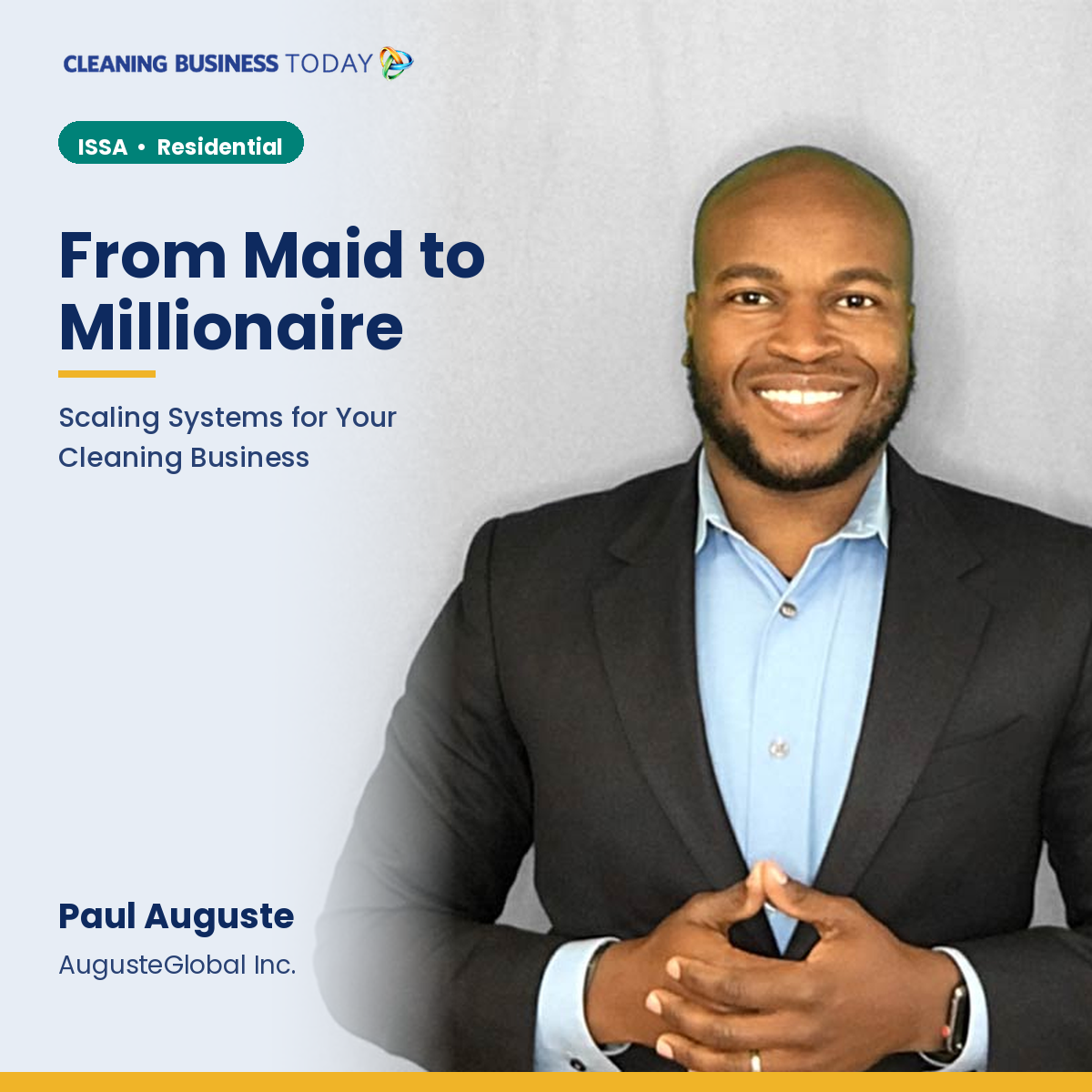
From Police Officer to Millionaire Business Owner: Paul Auguste Is Bringing His Scaling Playbook to ISSA Residential
Most cleaning business owners reach a point where growth stops feeling like progress. The schedule is full. The team is bigger. But the owner is still the one solving every problem — fielding the calls, fixing the scheduling gaps, and wondering when the business will start running without them. Paul Auguste knows that moment well. And he built his way out of it.
Auguste — a retired police officer, Army veteran, and founder of AugusteGlobal Inc. — grew his New Hampshire-based cleaning operation into a seven-figure business by doing one thing most owners resist: stop managing the work and start building the systems that manage it. He recently joined hosts Tom Stewart and Liz Trotter on Smart Business Moves to preview what he'll bring to his ISSA Residential session this November in Las Vegas.
Why You Almost Miss the Shift
Auguste opened the conversation with a question that cuts to the core of what keeps cleaning business owners stuck: what happens to your mindset when you're still operating inside the business every day?
"Getting in that mindset with other business owners around you — going from 'I'm an operator' to 'I'm the CEO'" — that's the shift that changes what's possible, Auguste explained. He argues that environment shapes that transition more than most owners realize. When you're fielding texts from the field and dispatching jobs from your kitchen table, your brain stays locked in operational mode. You hear the same ideas differently when you're surrounded by other owners who've already made the leap.
Tom Stewart, who first met Auguste at a MaidCentral booth at ISSA, has talked for years about the fiduciary responsibility that comes with being a CEO. It's not just phrasing. Auguste said that framing has stayed with him. "I say that all the time now," he noted. "When you come to that awareness, you behave differently."
That awareness — that you are running a company, not just doing jobs — is where Auguste's book begins.
Maid to Millionaire: The Book That Packages the Playbook

Auguste recently published Maid to Millionaire: The Service Business Blueprint to Scale Past $1M without Burning Out, a practical guide for cleaning business owners who want to scale from where they are to where the business can actually take them. He held up a copy on-screen during the Smart Business Moves recording — a physical book, written by someone who built the thing himself.
He describes the book's approach as the "shortest path." Not every path. Not every possible system. The one that works, kept as simple as it needs to be and no more.
The simplicity ethos came from hard experience. Auguste hired a general manager who, on his second day, looked at the company's pay structure and called it overcomplicated — not diplomatically. His critique stung. But Auguste made himself listen.
"I'm paying this guy to help us be better," he said. "I need to shut up and listen."
The GM rebuilt the pay model from scratch — clear, incentive-aligned, and easy for any employee to understand. The lesson stuck. Employees don't want to reverse-engineer their paycheck. They've been trading hours for dollars their whole career. If you want to incentivize them, great — but the path has to be visible. "Their rent is due," Auguste noted. "They're not thinking thirty, sixty, ninety days out."
Foundational Things That Don't Change
One of the most useful threads in Auguste's conversation with Stewart and Trotter is what he calls the fundamentals — the things that hold regardless of which business model you run.
Some operators swear by team-of-two with company cars. Others run solo cleaners in personal vehicles. Auguste did the research, built his model, and then watched the gig economy shift what recruits even expect. He got rid of his company cars years ago. Today's recruits are already driving for DoorDash and Uber. Providing their own car isn't the obstacle it used to be.
"There's many ways to scale," he said. "The world's always changing. But there are some foundational things that don't really change." Leadership is at the top of that list. So is profitability. And so is the discipline of keeping systems simple enough to actually use.
His book works across models because it's built on those constants — not on one operator's opinion of the right way to run a route.
See Paul Auguste Live at the ISSA Residential Convention
Paul Auguste will present at the Business Growth track at ISSA Show North America 2026, held November 16–19, 2026 at the Mandalay Bay Convention Center in Las Vegas.
His session runs 2:30–3:30 PM on November 17th — one hour of practical content on scaling a cleaning business through systems, leadership, and the mindset shift from operator to owner.
He'll also be giving away a limited number of autographed copies of Maid to Millionaire to attendees at the session. If you want one — and a chance to ask him directly how he built it — Las Vegas in November is where to be.
Not registered yet? Register for ISSA Show North America 2026 at issashow.com and use the code 26JOINUS548106 to get a 10% discount on your All Access Pass..
Auguste put it simply on the show: your competitors are watching to see whether you stay home and fight fires, or get in the room with people who can help you level up. That's the choice.
FAQs
A: Paul Auguste is a retired police officer, Army veteran, and founder of AugusteGlobal Inc. who scaled his cleaning business to millionaire level by building systems and automation. He teaches residential cleaning business owners how to step out of daily operations, simplify their pay structures, and lead their teams more effectively rather than managing every detail themselves.
A: Maid to Millionaire is Paul Auguste's book on scaling a cleaning business from daily operator to owner — covering systems, leadership, compensation structure, and the mindset shift required to build a company that doesn't depend on you running every job. Auguste describes it as the "shortest path": proven principles kept as simple as possible, applicable across different business models.
A: Paul Auguste is presenting a session at the ISSA Residential track at ISSA Show North America 2026 (November 16–19, Mandalay Bay, Las Vegas) focused on scaling a cleaning business through systems and the transition from operator to owner. His session runs 2:30–3:30 PM. He will also be giving away a limited number of autographed copies of Maid to Millionaire to attendees.
A: Simplifying a cleaning pay structure means making it easy for employees to calculate their own earnings without help. Auguste recommends clear hourly or incentive pay with visible milestones — built to match how employees actually think about money (in immediate, near-term terms) rather than around complex quarterly calculations. The more a pay model has to be explained, the less it motivates.
A: Being physically inside your operations every day keeps your mind locked in operator mode — solving the immediate problem in front of you rather than thinking strategically. Paul Auguste argues that putting yourself in a room with other business owners who are already scaling shifts how you hear and process ideas. An insight that would pass right over you on a Zoom call lands differently in person, surrounded by people facing the same transition.
A: An operator executes the work — dispatching teams, solving scheduling problems, handling client calls. A CEO builds the structure so those things happen without them. Paul Auguste and Tom Stewart both emphasize that recognizing you have a fiduciary responsibility as CEO changes how you make decisions — you're no longer just getting through the week, you're building the company that gets through it without you.
A: No — there are multiple models that work. Paul Auguste eliminated company vehicles from his operation and found that the gig economy (Uber, DoorDash, and similar platforms) has shifted recruits' expectations. Today's applicants are accustomed to using their own vehicles for work, which removes the friction that company car discussions used to create. The right model depends on your market and team structure, not a single industry standard.
Author

Recommended Reading
We've rounded up a few related posts you might like.
Top of the list is The “Paranoid” Advantage: Why the Smartest Cleaning Companies Are Hiring Employees That Never Clock Out, that explores Debbie Sardone's recommendations for using AI in your cleaning business.
Along similar lines, take a look at What the Data Says: Cleaning Business Benchmarks from the Professional Cleaning Index, where you'll find a year in review of the residential cleaning industry data, shared monthly by MaidCentral.
In a similar vein, there's Keep Your People, But With Better Results: 10 Turn-Key Ideas to Improve Staff Attendance and Quality, which walks through Martha Woodward's lessons from the field and from managing/operating a cleaning business and a performance quality software platform.
Closing things out, there's Cleaning Business Brand That Books Itself: ISSA 2026 Preview, that explores a brand-first strategy that empowered a home cleaning business to expand and scale into a multi-channel cleaning brand across multiple states.