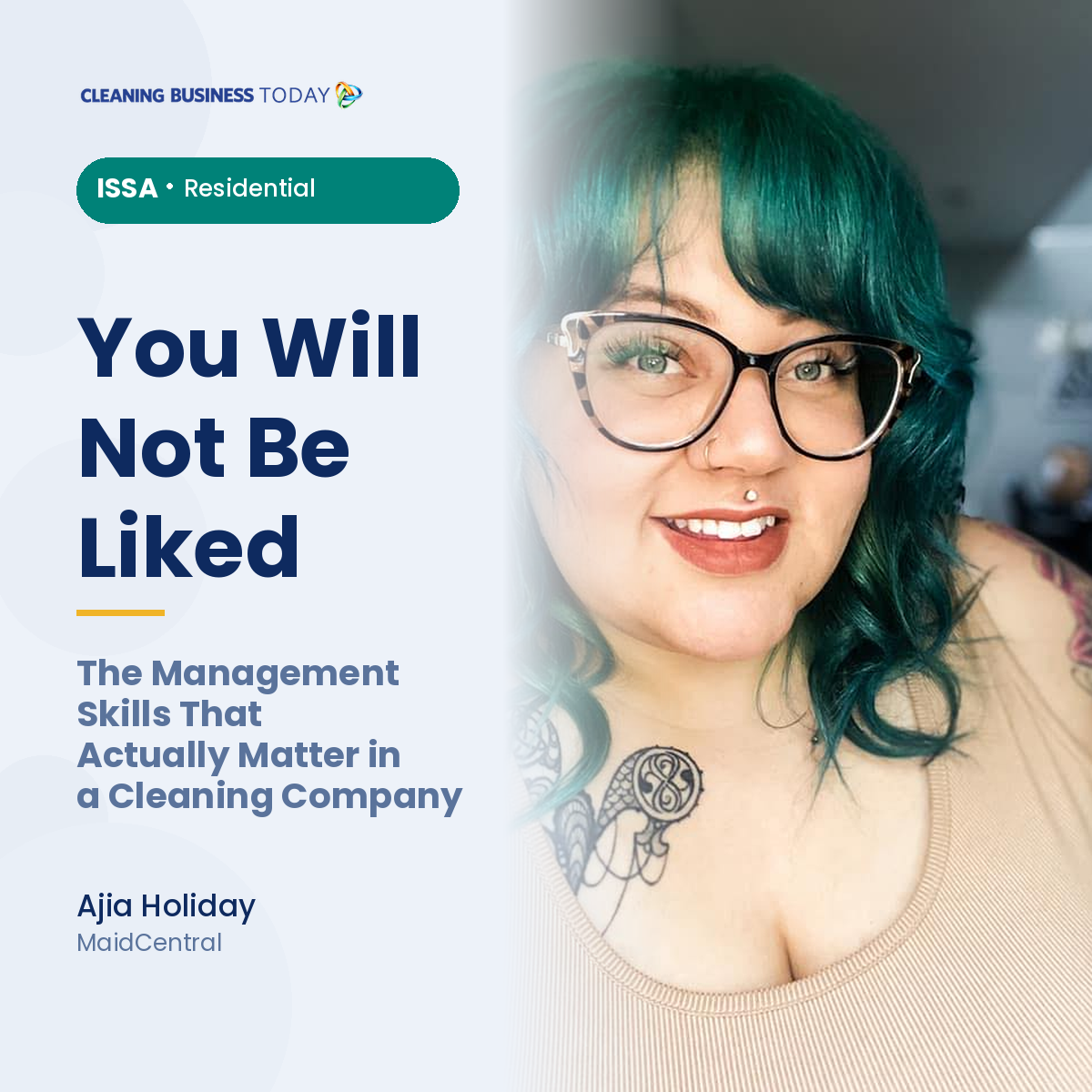
You Will Not Be Liked: The Management Skills That Actually Matter in a Cleaning Company
I've watched a lot of great cleaners get promoted into management and quietly struggle, not because they didn't know how to clean, but because nobody ever taught them how to lead the people they used to clean alongside.
There are a few reasons this transition is so rarely talked about honestly:
- Nobody wants to admit that leading a team you used to be part of feels awful at first.
- Owners assume good technicians will just "figure out" management on their own.
- Accountability gets treated like a personality trait instead of a system you have to build.
So what if the skills that actually make this transition work aren't the soft, motivational ones we default to, but a specific, learnable set of habits around authority, accountability, and communication?
In my ISSA Residential session, "You Will Not Be Liked: The Management Skills That Actually Matter in a Cleaning Company," I'm going to walk through exactly what those skills are, why the technician-to-leader pipeline in this industry makes them so hard to build, and what to do instead.
The Transition Nobody Prepares You For
Most managers in this industry didn't apply for a management job. They applied for a cleaning job, did it well, and were promoted into a role with little to no comprehensive training. That's a completely different starting point than management in most other industries, and it comes with a problem that's rarely said out loud: earning authority with a team that remembers when you were one of them is one of the hardest things you'll do in business.
In my first couple of months as a manager, I noticed some discrepancies in the mileage my old cleaning partner was submitting. I went back weeks, comparing what she'd logged against the actual Google Maps mileage, and found she was practically doubling it most days. This was the first time I'd ever had to hand a disciplinary issue to the owner, and it forced a decision I wasn't ready for. I didn't think it was malicious — I knew her well enough to know she had a tendency to exaggerate on a bad day — but "I don't think she meant it" isn't a system, it's a feeling, and feelings don't hold up when you're the one accountable for the numbers.
We ended up working out a payback plan for the extra paid mileage, and she agreed to stop estimating and start tracking it properly. Eventually, we built a different mileage submission process that removed the guesswork entirely, so it couldn't happen again with anyone. But that first attempt at holding someone accountable with objective data, rather than a gut feeling about whether they deserved the benefit of the doubt, was one of the hardest conversations I've had.
Accountability Is a System, Not a Trait
One of the biggest mistakes I see is treating accountability like something a manager either has or doesn't — like it's a personality trait, the way some people are naturally more patient or more organized. It isn't. Accountability is a system: clear expectations, consistent follow-through, and consequences that actually happen. Building that system with a team that used to see you as a peer takes more courage than building it with a team that never knew you any other way, because every enforced standard feels personal at first.
You Will Not Be Liked — And That's the Job
The hardest truth in the session is right there in the title. If you're leading a team well, there will be moments you are not liked for it. Learning to hold a standard anyway, without needing the team's approval to know you're doing your job right, is what actually separates managers who earn long-term respect from those who just hold the title.
What We'll Cover
We'll get specific about the management skills most commonly missing in cleaning companies, and why the usual technician-to-leader pipeline skips right past them. We'll talk through how to build real accountability systems with a team that knew you before you were in charge, and why most new managers avoid doing this until it's already costing them in turnover. And we'll cover communication and decision-making frameworks built specifically for field-based teams, not frameworks borrowed from office environments that don't translate to in-home service work.
Key themes Ajia covers:
- Making the leap from technician to leader without losing the respect of your team
- Building accountability systems that hold up under pressure, not just on paper
- Communication and decision-making frameworks built for field-based service teams
- Real-world lessons on leading people who remember when you were one of them
If you're an owner who came up through the field, a manager who got promoted without a roadmap, or a leader still figuring out who you are on the other side of that transition, this session is built for you.
Continue the Conversation at ISSA Residential
Join Ajia Holiday at ISSA Residential for a complete, interactive session featuring additional strategies, real-world examples, and practical implementation guidance you won't find in this article. View the full ISSA Residential Schedule.
Session: You Will Not Be Liked: The Management Skills That Actually Matter in a Cleaning Company
Booth: 2445 MaidCentral
Register for ISSA Residential and use the code 26JOINUS548106 to get a 10% discount on your All Access Pass.